
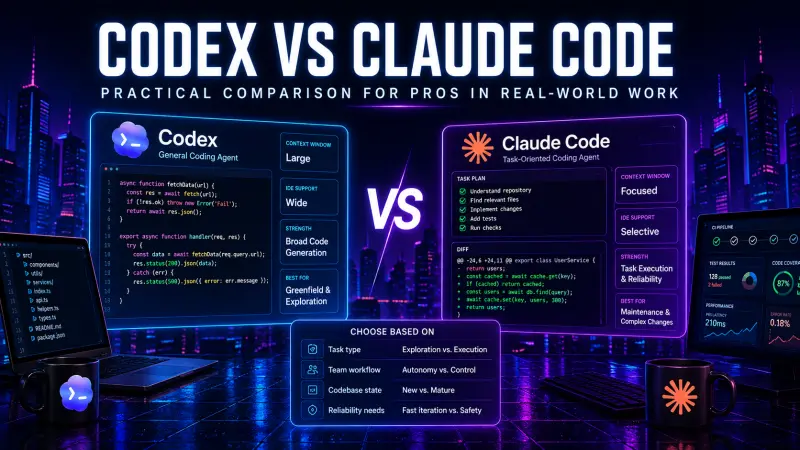
Codex vs Claude Code is most useful as an engineering workflow comparison, not a model personality contest. Both tools can inspect code, propose changes, work across files, and help with debugging. The difference that matters in professional work is how well they fit into the way your team already ships software.
The practical question is not “Which one writes better code?” It is “Which one reduces delivery friction without increasing review risk?” Senior engineers should evaluate these tools by task boundaries, failure modes, integration with tests, ability to preserve architecture, and how predictable they are when working inside a real repository.
What teams often get wrong
The common mistake is treating agentic coding tools as faster autocomplete. That underuses them and creates noisy output. Autocomplete helps inside a local edit. Agentic coding is more useful when the task has context, constraints, expected tests, and a clear definition of done.
A weak task looks like this:
# Bad task framing
"Refactor the payment module and make it cleaner."
That request is too broad. It does not define the boundary, risk level, migration rules, or validation path. Both Codex and Claude Code can produce plausible changes from it, but the reviewer now has to discover what changed and whether the agent silently rewired behavior.
A better task is closer to a production change request:
task: Refactor payment retry handling
scope:
  include:
    - src/payments/retry-policy.ts
    - src/payments/payment-service.ts
    - tests/payments/retry-policy.test.ts
  exclude:
    - database migrations
    - provider API clients
constraints:
  - preserve public method signatures
  - do not change retry intervals
  - keep logging keys stable
validation:
  - npm test -- tests/payments/retry-policy.test.ts
  - npm run typecheck
definition_of_done:
  - retry policy isolated behind a pure function
  - behavior covered by tests
  - no changes outside declared scope unless explicitly justified
This type of task framing matters more than tool choice. A disciplined prompt gives either agent a smaller search space and gives the reviewer a measurable acceptance checklist.
The best agentic coding workflow does not replace code review. It makes the review smaller, more testable, and easier to reject when the result crosses the boundary.
Codex vs Claude Code in real engineering tasks
The most useful comparison is operational. A senior team should look at lifecycle, context handling, local tooling, review safety, and how often a task needs human steering.
Criterion | Codex | Claude Code | What changes in production work |
|---|---|---|---|
Repository exploration | Strong fit for task-oriented code changes | Strong fit for deep multi-file reasoning | Both need explicit boundaries to avoid wide diffs |
Refactoring workflow | Good for scoped implementation and test-driven edits | Good for architectural cleanup and dependency-aware changes | Review quality depends on task constraints, not just output quality |
Terminal-centered work | Useful when tied to commands, tests, and local checks | Useful when the workflow is interactive and iterative | Works best when scripts are stable and deterministic |
Parallel task handling | Better suited when work can be split into independent tickets | Better suited when a single complex task needs iterative reasoning | Parallelization increases coordination cost |
Failure mode | Plausible implementation that may miss hidden project rules | Plausible reasoning that may overgeneralize architecture | Both require tests, diff review, and explicit stop conditions |
Best task shape | Small to medium scoped implementation, bug fixes, test generation | Complex diagnosis, multi-file refactor, design-sensitive edits | Use task type rather than brand preference as the selection rule |
Review burden | Low to medium for narrow diffs | Medium for broader architectural changes | Broader changes need stricter review gates |
Team adoption risk | Process drift if developers use inconsistent prompts | Process drift if conversations become undocumented design decisions | Shared task templates reduce variance |
This is not a universal ranking. In a mature engineering team, the better tool is often the one that fits the task boundary and review model with less friction.
Where Codex tends to fit well
Codex is a practical fit when the work can be expressed as a bounded change with clear commands. That includes feature slices, test generation, bug fixes, adapter implementation, and repetitive cleanup where the architecture is already known.
Good Codex-style tasks are usually:
narrow enough to inspect in one review pass
connected to a failing test, ticket, or acceptance rule
limited to a known module or package
easy to validate with existing commands
safe to reject without losing important design discussion
For example, a backend team might ask it to add a validation path to an existing endpoint while preserving the controller contract.
// Existing contract should stay stable.
export interface CreateInvoiceRequest {
  customerId: string;
  amountCents: number;
  currency: "USD" | "EUR" | "GBP";
}

export function validateCreateInvoice(input: unknown): CreateInvoiceRequest {
  if (!isObject(input)) {
    throw new ValidationError("Request body must be an object");
  }

  if (typeof input.customerId !== "string" || input.customerId.length === 0) {
    throw new ValidationError("customerId is required");
  }

  if (!Number.isInteger(input.amountCents) || input.amountCents <= 0) {
    throw new ValidationError("amountCents must be a positive integer");
  }

  if (!["USD", "EUR", "GBP"].includes(input.currency)) {
    throw new ValidationError("Unsupported currency");
  }

  return input as CreateInvoiceRequest;
}
A good instruction would not be “improve validation.” It would be: add tests for malformed payloads, preserve the interface, avoid changing the route handler, and run the validation test file. That makes the output reviewable.
Codex becomes less predictable when the task is vague, when repository conventions are implicit, or when the change requires understanding several layers of domain behavior that are not encoded in tests.
Where Claude Code tends to fit well
Claude Code is often useful for tasks that require sustained reasoning across files: explaining a legacy subsystem, identifying why a test suite became flaky, tracing control flow, or preparing a refactor plan before implementation.
That makes it a good fit for work where the first deliverable should not be code. In many senior workflows, the correct first output is a map of the system:
{
  "goal": "Explain why invoice finalization can run twice",
  "expected_output": {
    "call_paths": true,
    "shared_state": true,
    "race_conditions": true,
    "files_to_inspect": true,
    "proposed_fix": false
  },
  "rules": [
    "Do not edit files",
    "Separate confirmed facts from hypotheses",
    "List the tests that should exist before implementation"
  ]
}
This matters because complex agentic coding often fails when analysis and implementation are mixed too early. Claude Code can be effective when asked to reason first, then implement only after the developer accepts the plan.
A practical pattern is:
Ask for repository analysis only.
Ask for a change plan with file-level scope.
Review the plan.
Ask for implementation.
Run tests and inspect the diff.
Ask for a rollback or smaller patch if the change is too wide.
That workflow is slower than a single prompt, but it creates better control over architectural risk.
The review problem is the real bottleneck
Agentic coding tools can produce changes faster than teams can safely review them. That is the core production constraint. The bottleneck moves from writing code to validating intent.
The review burden increases when an agent:
touches files outside the requested scope
changes public interfaces without calling it out
updates tests to match broken behavior
removes edge cases because they look redundant
introduces helper abstractions without clear ownership
changes logging, metrics, or error semantics casually
The solution is not to ban broad tasks. The solution is to classify them.
Task type | Suggested tool posture | Review strategy | Risk level |
|---|---|---|---|
Add missing unit tests | Let the agent implement directly | Review assertions and fixtures | Low |
Fix a localized bug | Give failing test or reproduction | Review minimal diff and rerun tests | Low to medium |
Add a feature slice | Provide acceptance criteria and boundaries | Review API contract, tests, and edge cases | Medium |
Refactor a module | Request plan before code | Review dependency changes and behavior preservation | Medium to high |
Change architecture | Use agent for analysis, not autonomous edits | Human design review first | High |
Modify deployment or security config | Require explicit command and rollback plan | Review with DevOps or security owner | High |
Codex and Claude Code both perform better when the team defines what kind of task is being delegated. “Use AI to code faster” is not a workflow. “Use agents for bounded implementation after a testable task contract” is.
Testing: the control plane for both tools
Tests are not just validation after the agent finishes. They are the control plane that shapes the work.
A useful agent-ready repository has commands that are boring, stable, and narrow:
npm run typecheck
npm test -- tests/payments/retry-policy.test.ts
npm run lint -- src/payments
When test commands are unreliable, too slow, or dependent on hidden local state, both tools become harder to trust. The agent may still produce code, but the developer loses the fast feedback loop that makes the output safe.
For professional teams, improving test ergonomics is often the highest-return step before adopting any coding agent broadly. A repository with clear module boundaries, predictable fixtures, and focused test commands will get better results from both Codex and Claude Code.
Cost is not only token usage
Teams often compare these tools by subscription price or model cost. That is too narrow. The real cost profile includes review time, failed attempts, context rebuilding, CI usage, and the risk of merging plausible but incorrect code.
A useful internal cost model looks like this:
Cost factor | Low-risk usage | High-risk usage |
|---|---|---|
Prompt preparation | Reusable task templates | Ad hoc instructions per developer |
Review time | Small diffs with clear scope | Large diffs with unclear intent |
CI consumption | Targeted tests before full suite | Repeated full-suite runs for unstable patches |
Rework | Agent fixes localized failures | Humans unwind broad architectural changes |
Knowledge capture | Plans and decisions copied into tickets | Important reasoning trapped in chat history |
Production risk | Behavior protected by tests | Behavior inferred from generated code |
This is where senior judgment matters. An agent that saves 30 minutes of coding but adds 90 minutes of review is not improving throughput. A tool that turns a vague bug into a reproducible failing test can be valuable even before it writes the fix.
Practical adoption strategy
The safest way to compare Codex and Claude Code is not a generic bake-off. Run them against your actual work categories.
Start with four internal task classes:
Bug reproduction: Can the tool identify the failing path and create a useful test?
Localized implementation: Can it change one module without widening scope?
Refactor planning: Can it explain dependencies and propose a safe sequence?
Review assistance: Can it summarize a diff, identify risk, and suggest missing tests?
Then evaluate outputs with engineering criteria:
changed files count
public API changes
test quality
unnecessary abstractions
correctness of assumptions
ability to follow constraints
ease of review
rollback simplicity
Do not start with the hardest architectural task. Start where rejection is cheap. Once the team has task templates and review rules, move toward more complex work.
A practical team policy can be short:
agent_policy:
  allowed_without_plan:
    - unit test generation
    - localized bug fixes
    - documentation updates for existing behavior
  requires_plan_first:
    - multi-file refactors
    - dependency changes
    - database-related changes
    - authentication or authorization changes
  never_merge_without_human_owner:
    - security-sensitive code
    - production deployment configuration
    - public API contract changes
    - billing or payment behavior
This policy does not slow the team down. It prevents agent output from bypassing engineering ownership.
Which one should a professional team choose?
Use Codex when the task is implementation-heavy, bounded, and easy to validate through commands. It is a strong fit for structured tickets, test-backed changes, and workflows where developers want the agent to execute against a clear scope.
Use Claude Code when the task requires deeper repository understanding, iterative diagnosis, or a plan before implementation. It is a strong fit for legacy code exploration, broad refactoring analysis, and situations where the first deliverable should be reasoning rather than a patch.
Many teams will use both, but not randomly. The operational split should look like this:
Codex for scoped delivery tasks
Claude Code for diagnosis, planning, and complex change exploration
Human engineers for architecture decisions, trade-off ownership, and final merge responsibility
That division keeps the tools useful without pretending they replace engineering judgment.
Validate the workflow, not just the tool
For engineers who use AI-assisted coding in real delivery workflows, the relevant next step is to validate the practices behind the comparison: task scoping, repository context, review discipline, verification, safe automation, and production-aware judgment. Review the AI-Assisted Developer: Codex and AI-Assisted Developer: Claude Code certifications if these tools are part of your day-to-day engineering work.
Conclusion
Codex vs Claude Code is not a winner-takes-all comparison. In professional software work, both are useful only when the team controls scope, validation, and review. The strongest results come from treating agentic coding as a structured delivery workflow, not as a shortcut around engineering discipline.
For senior teams, the next step is practical: define task templates, require plans for broad changes, improve narrow test commands, and measure review cost. The tool that fits those constraints with less friction is the better choice for that part of the workflow.