
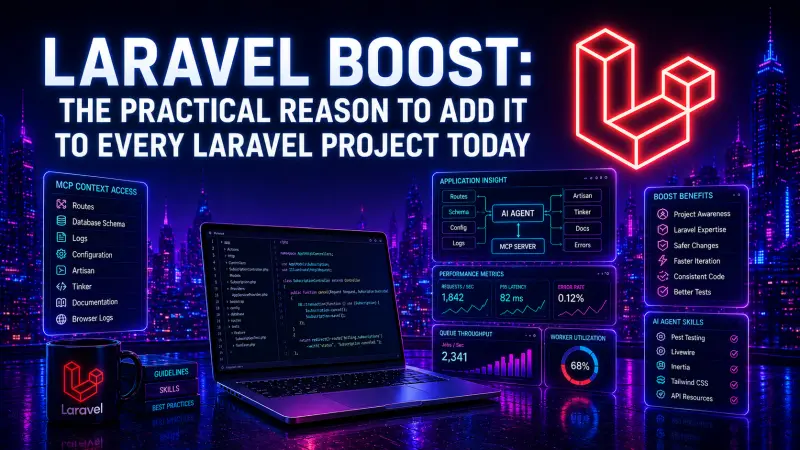
Laravel Boost matters because most AI-assisted Laravel development fails for a predictable reason: the agent does not understand the project it is changing. It may know generic PHP, common Laravel patterns, and fragments of public documentation, but it does not automatically know your installed package versions, your routes, your schema, your conventions, or the error that just appeared in your logs.
Boost changes that workflow from prompt-based guessing to application-aware assistance. It is a development dependency, not a production feature, and that distinction is important. The value is not that Laravel Boost “writes code for you.” The value is that it gives AI coding agents enough verified context to produce smaller, more relevant diffs that senior engineers can review instead of rewrite.
What Laravel Boost Actually Does
Laravel Boost is a first-party development tool for AI-assisted Laravel work. It provides an MCP server, AI guidelines, agent skills, and access to Laravel ecosystem documentation that is matched to the packages and versions in the project.
In practical terms, Boost allows an AI coding agent to inspect parts of the application instead of relying only on the text you paste into a chat window. Depending on the setup, the agent can work with information such as:
PHP and Laravel versions
installed Laravel ecosystem packages
application routes
configuration keys
database schema
database connections
log entries and recent errors
browser logs
Artisan commands
Tinker execution
version-aware Laravel documentation
framework and package-specific coding guidelines
That is a major difference from a generic assistant. A generic assistant may suggest a method that existed in another version, ignore your project structure, invent a relationship name, or write a test against a route that does not exist. Boost reduces those failure modes by giving the agent structured access to the actual project state.
The Real Problem: AI Without Project Context
The common mistake is treating AI coding tools as if the model alone is the product. For Laravel teams, the model is only one part of the workflow. The more important question is: what context does the agent have before it edits code?
Without Boost, teams often compensate with long prompts:
“Use Laravel 12 conventions.”
“We use Pest, not PHPUnit.”
“This project uses Inertia with Vue.”
“Please check existing actions before creating new services.”
“The database has a
subscriptionstable with these columns.”“Do not use deprecated APIs.”
This does not scale. Prompts are not a reliable engineering interface. They are easy to forget, hard to standardize across a team, and fragile when the project changes.
The practical value of Laravel Boost is not faster typing. It is reducing the amount of missing context between the codebase and the tool that is about to modify it.
Old AI Workflow vs Boost-Aware Workflow
Workflow area | Generic AI assistant | Laravel Boost-assisted agent |
|---|---|---|
Project context | Mostly pasted manually | Discovered from the application |
Laravel version awareness | Model-dependent | Guided by detected project versions and documentation |
Database understanding | Usually copied into prompt | Can inspect schema through MCP tools |
Route awareness | Manual or guessed | Can inspect application routes |
Error diagnosis | User pastes logs | Can read relevant logs when configured |
Test style | Often inferred incorrectly | Can follow project guidelines and installed tools |
Review burden | Higher risk of broad rewrites | Smaller chance of irrelevant changes |
Team consistency | Depends on individual prompts | Shared guidelines and skills can be committed or regenerated |
Operational risk | Low if used carefully, but context is weak | Better context, but requires explicit dev-tool boundaries |
The table does not mean Boost makes AI output safe by default. It means the failure mode changes. Instead of reviewing code generated from vague assumptions, you review code generated with more application-specific evidence.
Installing Boost Should Be Part of the Project Baseline
For a modern Laravel project where developers use AI coding agents, Boost should be treated like a baseline development tool, similar to Pint, Pest, static analysis, or IDE helper files. It belongs in the development workflow because it improves the quality of the work before code review starts.
A typical setup is straightforward:
composer require laravel/boost --dev
php artisan boost:install
After installation, Boost generates agent-specific configuration, guidelines, and skills based on the tools selected during setup. For teams, the important follow-up is not only “does it run?” but “does every developer get the same useful context?”
A practical baseline should include:
installing Boost as a dev dependency
enabling it in the team’s preferred AI agent or editor
keeping generated resources updated after dependency changes
documenting which MCP tools are acceptable in local development
using sandbox or local data when allowing database access
making tests and code review mandatory for generated changes
Boost is most useful when it becomes part of the engineering system, not a personal productivity experiment hidden on one developer’s machine.
MCP Is the Key Architectural Shift
The Model Context Protocol part of Boost is important because it gives the coding agent callable tools. Instead of asking the user to describe the application, the agent can request structured information from the Laravel project.
For manual MCP registration, the shape is intentionally simple:
{
  "mcpServers": {
    "laravel-boost": {
      "command": "php",
      "args": ["artisan", "boost:mcp"]
    }
  }
}
This is a local development interface. It should be handled with the same caution as any tool that can read logs, query data, or execute framework code. In a professional team, that means avoiding production credentials, using local environments, and reviewing what the agent is allowed to do.
The benefit is clear: the agent can reason from the running application rather than from stale assumptions. If it needs to understand a failed request, it can inspect errors. If it needs to generate a query or model relationship, it can check the schema. If it needs to use a Laravel API, it can search documentation matched to the project’s ecosystem.
Guidelines and Skills Turn Team Conventions Into Reusable Context
Boost is not only about tool access. Its guidelines and skills are just as important for maintainability.
Guidelines are broad instructions loaded upfront. They help the agent follow Laravel conventions, testing expectations, and package-specific patterns. Skills are more focused modules that activate for particular tasks, such as Livewire development, Inertia work, Tailwind changes, or Pest testing.
This matters because real Laravel projects are not defined only by the framework. They are defined by local decisions:
where business logic lives
whether controllers delegate to actions
how requests are validated
how authorization is checked
how tests are named and organized
how frontend routes and forms are structured
what should never be generated automatically
Teams can add project-specific guidelines so agents stop rediscovering the same rules in every session.
Example guideline content:
# Billing Domain Guidelines

- Put billing use cases in App\Actions\Billing.
- Do not place payment provider calls directly in controllers.
- Use FormRequest classes for validation on write endpoints.
- Prefer feature tests for checkout and subscription state changes.
- Never generate migrations that rename billing columns without a rollback plan.
This is not a replacement for architecture documentation. It is a way to make architecture documentation operational inside the coding workflow.
Keep Boost Resources Updated With Dependencies
Laravel projects change. Packages are upgraded, testing tools shift, frontend stacks evolve, and team conventions mature. Boost resources should be updated as part of that lifecycle.
A simple Composer hook can make updates harder to forget:
{
  "scripts": {
    "post-update-cmd": [
      "@php artisan boost:update --ansi"
    ]
  }
}
This does not remove the need for review, but it keeps the local AI context closer to the installed dependency graph. That is the point: AI assistance should track the project, not drift away from it.
Where Boost Helps Most
Boost has the highest impact in work where the agent needs both Laravel knowledge and project-specific state.
Good candidates include:
creating feature tests that match existing routes and models
debugging errors that involve logs, browser output, or configuration
generating CRUD flows in established project conventions
working with Inertia, Livewire, Pest, Tailwind, or similar ecosystem tools
refactoring controllers into actions or services
checking whether a suggested API matches the installed package version
preparing framework upgrade work with guided prompts and reviewable diffs
The best use cases are not “build an entire feature from one sentence.” The best use cases are bounded tasks with verifiable outcomes.
For example, a weak request is:
Build subscriptions.A better Boost-aware request is:
Inspect the existing billing models, routes, and tests.
Add a feature test for canceling an active subscription,
then implement the smallest change needed to pass it.
Follow the project's existing action class pattern.
That prompt gives intent. Boost supplies context. Tests provide verification. Code review remains the final control.
What Boost Does Not Solve
Laravel Boost should be used in every serious Laravel project that uses AI-assisted development, but it should not be misunderstood.
It does not remove the need for:
senior engineering judgment
test coverage
code review
database safety
architecture boundaries
security review
domain knowledge
release discipline
It also does not guarantee that generated code is correct. AI-generated output is still a draft. Boost reduces avoidable errors caused by missing context, but it cannot decide whether a business rule is valid, whether a migration is safe for production data, or whether a refactor is worth the coordination cost.
This is why the correct adoption model is controlled enablement, not blind automation.
A Practical Adoption Checklist
For teams adopting Laravel Boost, start with the workflow rather than the tool excitement.
Install Boost as a dev dependency.
Enable it in the coding agents used by the team.
Add or refine project-specific guidelines.
Keep generated resources updated after dependency changes.
Use local or sandbox data for database-aware workflows.
Require tests for generated feature work.
Review diffs as seriously as human-written code.
Track repeated AI mistakes and convert them into guidelines.
This creates a feedback loop. Every time the agent gets something wrong because the project rule was implicit, make the rule explicit.
For engineers who work with Laravel professionally and want to validate senior-level framework judgment beyond tool usage, the most relevant certification to review is Senior Laravel Developer.
Conclusion
Laravel Boost is useful because it addresses the real bottleneck in AI-assisted Laravel development: missing context. Generic AI tools can generate plausible PHP. Boost helps them generate Laravel code that is closer to the application, the installed ecosystem, and the team’s conventions.
That makes it a practical default for modern Laravel projects. Not because it replaces developers, and not because every generated diff will be correct. It belongs in the baseline because it lowers the cost of using AI responsibly: fewer guessed APIs, less manual context copying, better alignment with project structure, and more reviewable output.
Use Boost early, define team guidelines, keep it updated, and treat the generated code as a draft that must pass the same engineering standards as everything else.