
Go makes it unusually easy to start an HTTP API with very little code. That is both a strength and a trap. A team can ship quickly with net/http, chi, echo, or fiber, but the real cost appears later: routing conventions, middleware behavior, request binding, error handling, testing style, and how much framework-specific knowledge becomes embedded in the codebase.
The useful question is not “which Go HTTP framework is more popular?” A better question is: which approach will still be understandable, testable, and safe to modify when the original authors are busy, the product has grown, and the API has accumulated edge cases?
The maintenance problem is rarely the router
Most Go HTTP API discussions over-focus on routing syntax. Routing matters, but it is not usually what makes an API hard to maintain. The larger issues are:
handlers that mix transport, validation, business logic, persistence, and response formatting
middleware that hides control flow
framework-specific context objects spreading through the service layer
inconsistent error responses across endpoints
tests that require a full application boot instead of exercising handlers directly
convenience helpers that become difficult to replace later
A router should help organize HTTP concerns. It should not become the architectural center of the application.
The healthiest Go API is usually the one where replacing the router would be annoying, not catastrophic.
That principle changes how we compare the standard library, chi, echo, and fiber.
The baseline: standard library first
The Go standard library is not a “no framework” compromise. For many APIs, net/http is enough: request parsing, handlers, middleware composition, response writing, and testing are all available without adding a dependency.
A small API can start like this:
package main

import (
	"encoding/json"
	"log"
	"net/http"
)

type HealthResponse struct {
	Status string `json:"status"`
}

func healthHandler(w http.ResponseWriter, r *http.Request) {
	w.Header().Set("Content-Type", "application/json")
	json.NewEncoder(w).Encode(HealthResponse{Status: "ok"})
}

func main() {
	mux := http.NewServeMux()
	mux.HandleFunc("GET /health", healthHandler)

	log.Fatal(http.ListenAndServe(":8080", mux))
}
This style has a few long-term advantages. New Go developers understand it quickly. Tests can use httptest without framework setup. Middleware can remain plain functions. There is no custom context type to leak into application code.
The trade-off is that larger APIs require discipline. Without a framework, teams need to define conventions for path parameters, validation, request decoding, error responses, observability, and route grouping. The standard library gives you a stable foundation, but it does not give you a full API structure.
chi: small surface area, low lock-in
chi is often a natural next step when net/http starts to feel too manual. Its main benefit is not that it has a prettier router. Its benefit is that it stays close to standard Go HTTP primitives.
A chi handler still looks like a normal http.HandlerFunc:
package api

import (
	"encoding/json"
	"net/http"

	"github.com/go-chi/chi/v5"
)

func getUser(w http.ResponseWriter, r *http.Request) {
	userID := chi.URLParam(r, "id")

	json.NewEncoder(w).Encode(map[string]string{
		"id": userID,
	})
}

func Routes() http.Handler {
	r := chi.NewRouter()

	r.Get("/users/{id}", getUser)

	return r
}
For long-term maintenance, that is important. Middleware can still use the standard func(http.Handler) http.Handler shape. Tests can call the router as an http.Handler. Existing Go HTTP tooling fits naturally.
chi adds useful structure without changing the programming model too much. That makes it suitable for teams that want routing, middleware composition, and route grouping, but do not want the framework to dictate the whole service shape.
echo: productive, but easier to couple to
echo provides more built-in API ergonomics. Its context object supports path parameters, binding, JSON responses, and other request-scoped helpers. That can reduce boilerplate and make endpoint code shorter.
package api

import (
	"net/http"

	"github.com/labstack/echo/v4"
)

type CreateUserRequest struct {
	Email string `json:"email"`
}

func createUser(c echo.Context) error {
	var req CreateUserRequest
	if err := c.Bind(&req); err != nil {
		return c.JSON(http.StatusBadRequest, map[string]string{
			"error": "invalid_request",
		})
	}

	return c.JSON(http.StatusCreated, map[string]string{
		"email": req.Email,
	})
}
The maintenance risk is coupling. If handlers pass echo.Context into services, validators, repositories, or background jobs, the application starts depending on echo outside the HTTP boundary. That makes tests heavier and future migration harder.
echo can work well when the team enforces a boundary:
use
echo.Contextonly inside HTTP handlersconvert framework input into plain request structs
return application errors from services
centralize error-to-response mapping
keep business logic free of framework imports
Without that discipline, echo convenience can spread quickly.
fiber: fast ergonomics, different HTTP model
fiber has an API style familiar to developers coming from Express-like frameworks. It can feel productive for teams that value compact route definitions and middleware chains.
package api

import "github.com/gofiber/fiber/v2"

func Register(app *fiber.App) {
	app.Get("/health", func(c *fiber.Ctx) error {
		return c.JSON(fiber.Map{
			"status": "ok",
		})
	})
}
The main maintenance consideration is that fiber does not use net/http as its primary handler model. That affects integration expectations. Standard Go HTTP middleware, tests, and libraries may not plug in as directly as they do with net/http-based routers.
This does not make fiber wrong. It means the team should choose it consciously. If the service is mostly self-contained and the team prefers fiber’s style, it can be productive. If the organization already has net/http middleware, shared observability wrappers, internal testing utilities, or platform conventions, fiber may increase adaptation work.
Operational comparison for teams
The practical differences show up most clearly when the API is no longer new.
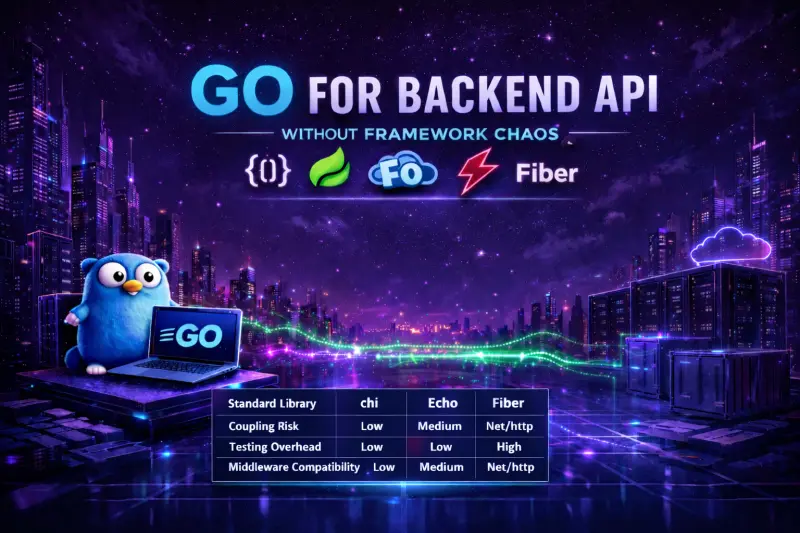
Approach | Handler model | Framework coupling risk | Middleware portability | Testing overhead | Team convention required | Migration cost |
|---|---|---|---|---|---|---|
Standard library | net/http | Low | High | Low | High | Low |
chi | net/http | Low to Medium | High | Low | Medium | Low to Medium |
echo | Framework context | Medium to High | Medium | Medium | Medium | Medium |
fiber | Framework context | Medium to High | Lower for net/http tools | Medium | Medium | Medium to High |
The table is not a ranking. It shows where maintenance pressure tends to appear.
If your company has shared HTTP middleware, platform logging, tracing conventions, and test helpers built around net/http, chi or the standard library usually reduce coordination cost. If your team wants more built-in request handling and accepts a framework boundary, echo can be reasonable. If your team strongly prefers fiber’s programming model, make sure platform integration is evaluated before the service becomes critical.
The pattern that matters more than the framework
The most maintainable Go APIs usually separate transport code from application code. The handler should parse HTTP input, call a service, and map the result back to HTTP. It should not contain the whole use case.
A framework-neutral service boundary looks like this:
package users

import (
	"context"
	"errors"
)

var ErrEmailTaken = errors.New("email already taken")

type CreateUserInput struct {
	Email string
}

type Service interface {
	CreateUser(ctx context.Context, input CreateUserInput) (User, error)
}

type User struct {
	ID    string
	Email string
}
Then the HTTP layer adapts to that boundary:
func createUserHandler(svc users.Service) http.HandlerFunc {
	return func(w http.ResponseWriter, r *http.Request) {
		var req struct {
			Email string `json:"email"`
		}

		if err := json.NewDecoder(r.Body).Decode(&req); err != nil {
			writeError(w, http.StatusBadRequest, "invalid_request")
			return
		}

		user, err := svc.CreateUser(r.Context(), users.CreateUserInput{
			Email: req.Email,
		})
		if err != nil {
			writeError(w, statusFor(err), codeFor(err))
			return
		}

		writeJSON(w, http.StatusCreated, user)
	}
}
This design works with net/http, chi, echo, or fiber. The adapter changes, but the core use case does not. That is the difference between using a framework and letting a framework own the application.
What teams often get wrong
The most expensive mistakes are not visible in the first sprint.
First, teams often allow every handler to invent its own response format. Six months later, clients receive different error structures from neighboring endpoints. Fixing that becomes a breaking-change discussion.
Second, request validation gets scattered. Some fields are checked during binding, others in handlers, others in services. A maintainable API needs a clear rule: transport validation belongs near the handler, business invariants belong in the application layer.
Third, middleware becomes a dumping ground. Authentication, logging, panic recovery, correlation IDs, rate limits, and authorization checks are not the same kind of concern. Combining them into large middleware chains makes debugging harder, especially when failures depend on ordering.
Fourth, framework context leaks into places where it does not belong. A service method that accepts *fiber.Ctx or echo.Context is no longer a clean application service. It is an HTTP endpoint in disguise.
A practical selection guide
Choose the standard library when:
the API is small or internally scoped
the team values minimal dependencies
you already have strong internal conventions
portability and explicitness matter more than convenience
Choose chi when:
you want standard
net/httpcompatibilityroute grouping and middleware composition matter
the API is expected to grow
the team wants low framework lock-in
Choose echo when:
the team benefits from built-in API helpers
convention is enforced through code review
you can keep echo-specific types at the transport boundary
productivity matters, but not at the cost of service-layer coupling
Choose fiber when:
the team prefers its programming model
the service does not need deep
net/httpmiddleware compatibilityplatform integrations have been tested early
the framework boundary is accepted as a design decision
For most long-lived business APIs, the safest default is either standard library plus conventions or chi plus a clean application boundary. echo and fiber can still be good choices, but they require more attention to where framework-specific types are allowed.
What to adopt first
Before changing frameworks, standardize the parts that actually affect maintenance:
Define one error response shape.
Keep services free of HTTP framework imports.
Use request and response structs instead of loose maps.
Make middleware small and ordered deliberately.
Write handler tests with fake services.
Put route registration in one predictable place per module.
Treat framework context as transport-only state.
Those decisions survive framework changes. They also make the current framework less dangerous.
For engineers who work on Go APIs professionally and want to validate production-oriented backend judgment, the most relevant certification to review is Senior Go Developer.
Conclusion
The best Go HTTP stack is not the one with the most features. It is the one your team can reason about after the API has grown, people have changed projects, and production behavior matters more than initial speed.
Start with the smallest abstraction that solves your routing and middleware needs. Prefer standard net/http compatibility when organizational tooling depends on it. Use framework conveniences only at the edge. Keep business logic in plain Go types, behind explicit service boundaries.
That is how you avoid framework chaos: not by refusing frameworks, but by making sure the framework remains a transport tool, not the architecture.